The Kinetic Laboratory
Four years, eight thousand miles, and one used Lotus Exige S — a hands-on education in thermodynamics, kinematics, and friction, and an argument that nothing mechanical is ever finished.
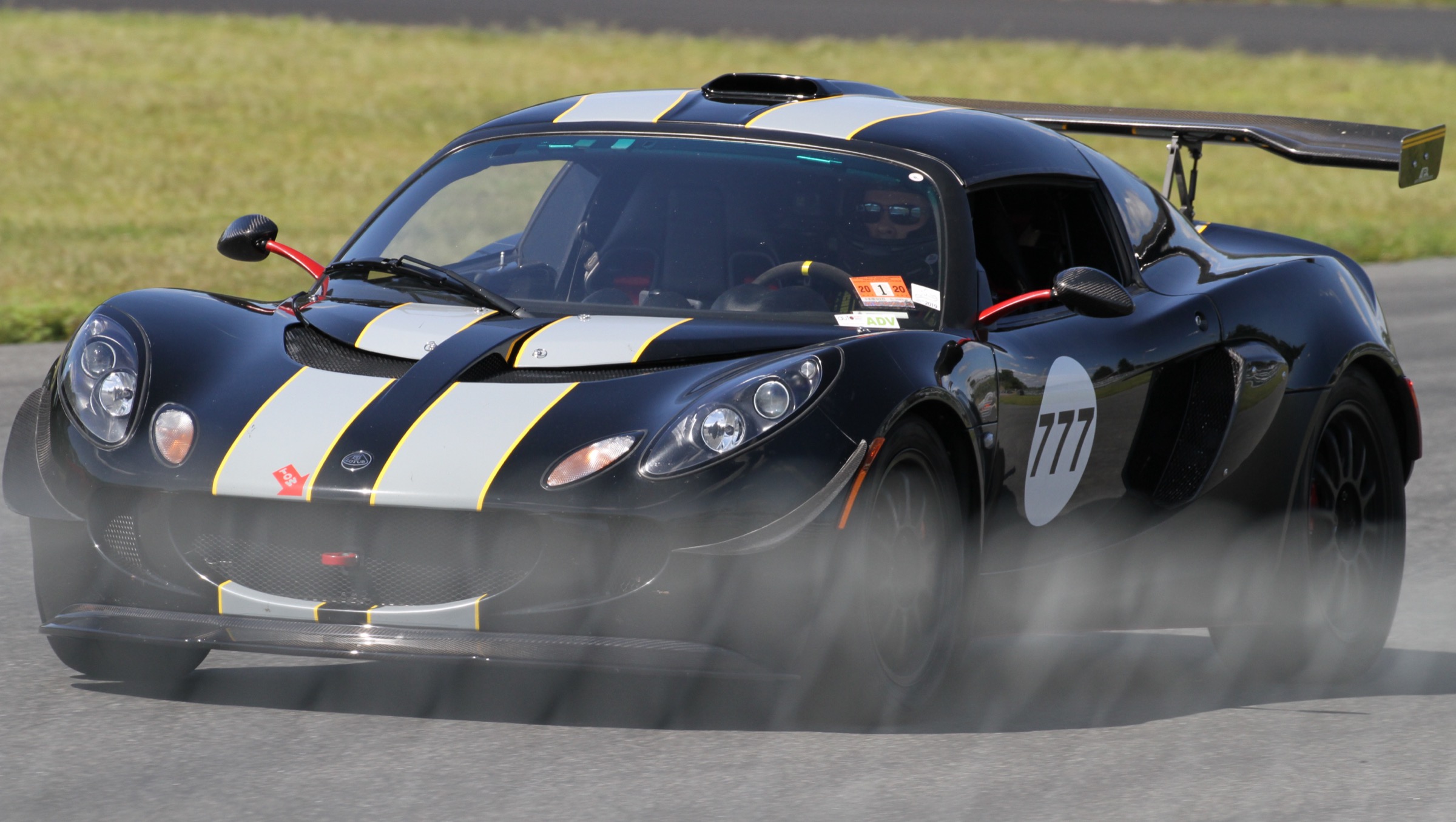 Pitt Race
 The blank slate
I bought my 2007 Lotus Exige S used, nearly stock, and quietly a little broken. I didn’t have a whole lot of experience working on cars and the fastest thing I had ever owned was a Ford Focus. What I had was a car built on an idea I found irresistible: super-light aluminum weighing about 2,000 pounds, a mid-mounted engine, and almost nothing else. No electronic safety net to hide imperfections, of which I have many as a driver. It was, in the most literal sense, a blank slate — an adult go-kart.
Why a Lotus is the simplest part of the story. My dad had a Lotus Elan when I was growing up, and he never quite stopped talking about how fun it was — not fast in the modern sense, but light and direct in a way that nothing he drove afterward ever was. That stuck. I bought the Exige out of that, with no master plan for the ultimate track car — just a quiet conviction that Colin Chapman’s old line about adding lightness was the most interesting idea in performance cars, and a willingness to find out where it took me. Everything that follows is what happened when I started pulling on that thread.
One thing up front: a near-stock Exige is not a wrong car. It is a wonderful car. But nothing mechanical is ever perfect, and any street car can be made better, with admitted trade-offs. That gap between “good” and “better,” and the price you pay to cross it, is what this whole project was about. I went deep on thermodynamics, kinematics, and friction science not because the car demanded it but because I wanted to improve the car as I improved as a driver. The two turned out to be the same project.
There was also the plain matter of the car being used, and some things were genuinely wrong. The pre-cat oxygen sensor turned out to be a counterfeit — a knock-off pretending to be a Bosch — so the ECU had been guessing at its own fueling for a while. Both sensors got replaced with genuine Bosch units. The oiled-foam air filter was filthy; I cleaned and re-oiled it, cleaned the mass-airflow sensor, and fitted fresh iridium plugs. The track harnesses were also past their certification date, which meant a new set before I took it anywhere near a paddock.
The engine deserves its own paragraph. The 2ZZ-GE is a 1.8-liter four that Toyota and Yamaha built together — high-revving, an 8,000-rpm redline, a clever variable-valve-lift system, and cylinder liners made of a metal-matrix composite finished by electrochemical machining. Score a cylinder wall and there’s no clean-up pass; you’re into a new block or expensive sleeving. That set the priority for everything that followed: build enough cooling and lubrication headroom that the engine would survive whatever I was about to ask of it.
- Model
- 2007 Lotus Exige S
- Chassis
- Epoxy-bonded aluminum tub~2,057 lb dry
- Engine
- 1.8L 2ZZ-GE, Eaton M62 supercharger~8,000 rpm redline
- Power
- ~218 hp crank~200–220 whp at the wheels
- Power-to-weight
- ~10 lb per hpon the dry-weight figure — the whole point
- Balance
- ≈ 40 / 60 front-to-rear
- Odometer
- ~12,300 miles
- First fixes
- Counterfeit O2 sensor, filthy filter, tired plugs
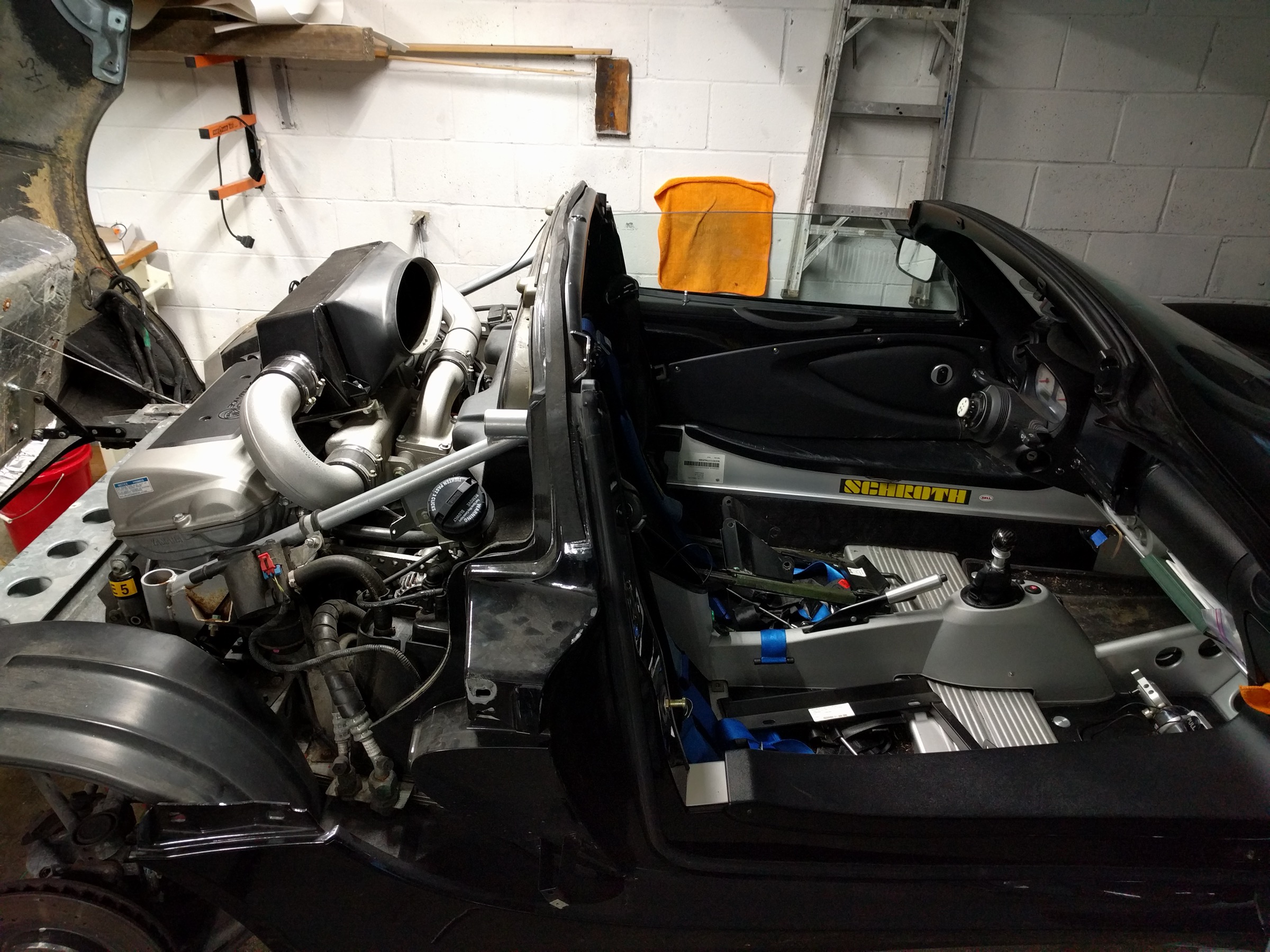 Dec 2015
 The language of grip
Before I could make the car faster, I had to learn how it talked to the road. Vehicle dynamics — every lap time, every input at the wheel — comes back to four patches of rubber roughly the size of your palm. The contact patches. That is the entire interface between two thousand pounds of car and the asphalt. Get those four patches loaded properly and the car works. Almost every decision downstream is a longer way of saying that.
Fred Puhn’s How to Make Your Car Handle is the book that taught me to frame every alignment decision that way — as a means of keeping the patches flat and evenly loaded once the chassis starts working. The terminology in the next few paragraphs is borrowed from him.
Camber is the vertical tilt of the wheel as you look at the car head-on. Negative camber leans the top of the tire inward. It is aggressive for a daily street car — driven straight on the road, a strongly cambered tire carries most of its load on the inner edge of the tread and wears that edge out — but it is exactly right in a corner. The key concept here is tire roll. As the chassis leans into a turn and weight transfers across the car, the loaded outside tire takes a hard lateral load and the sidewall deflects under it; the carcass rolls outward on the rim and the contact patch climbs onto the outer shoulder of the tread. An upright tire ends up balancing on a narrow strip near its outer edge, with the rest of the rubber levered off the asphalt. Dial in static negative camber and the geometry has somewhere to go: by the time the car is fully loaded mid-corner, the static tilt has been used up by tire roll and the patch lies flat against the track instead of being levered off it.
Toe is the direction the wheels point seen from above. Toe-in gives straight-line stability; toe-out gives sharper turn-in. Both cost something. Any toe at all is a permanent sideways scrub — a little heat and drag the tires pay on every straight, traded for the way the car behaves when you actually ask it to do something.
The Exige has its own accent. With the engine behind the driver the weight sits roughly 40 percent front, 60 percent rear, and the factory deliberately dials in a little understeer. Push past the limit on the street and the front washes wide before the rear lets go. That bias is on purpose; understeer is the safer failure mode. The Exige’s real signature is what happens when the rear does eventually let go. The wheelbase is short and the heavy bits — engine, driver, fuel — sit clustered near the middle, which is to say the polar moment of inertia is low. A longer, more spread-out car loses rear grip and there’s a lot of rotational inertia to wind up; the slide builds slowly. A car like this one loses rear grip and there isn’t, and it doesn’t. It rotates fast. That’s snap oversteer — the general label for any short-wheelbase, low-polar-moment car that loses the rear in a hurry — and the only way it gets caught is with fast hands. Most of what follows in this post is, in one way or another, about taking the surprise out of that moment. A square alignment, a corner-balanced chassis, and stiff, repeatable suspension pivots all give the rear a chance to talk to you before it lets go: the slide arrives gradually, you feel it coming, and snap oversteer becomes regular oversteer that you can drive through. The setup never eliminates the failure mode — the polar moment is what it is. It just makes the car predictable, so that the only real way to provoke a snap is the driver’s mistake. On a car with sharp throttle response that mistake almost always wears the same shape: lift-off oversteer. Snap the throttle shut mid-corner, weight pitches forward, the rear tires unload, and the car rotates exactly in the direction you didn’t want. It is the rookie error on a mid-engined car, and I made it more than once before I learned to keep my right foot honest. Predictability buys you a margin. Smooth inputs and fast hands are still what keep the car pointed.
What that meant in numbers, on this car, was an orthodox Exige track alignment paired with BWR’s suspension recipe. The alignment landed at about −2.5° of front camber and −2.0° at the rear — enough to leave for tire roll without scrubbing the inner edges off the tread on the street — with a touch of toe-out up front for sharper turn-in and a touch of toe-in at the rear for stability under load. Underneath, the springs are 500 lb/in front and 700 lb/in rear, on Penske single-adjustable dampers built to BWR’s spec, with BWR’s adjustable anti-roll bars on both ends. The rates are stiff enough to keep body roll honest without being punishing on the drive there, and the adjustable bars give a single knob per axle for dialing understeer or oversteer back to neutral at a given track. All of it serves the same purpose this section has been circling: keep the chassis from rolling so far, and the tire from deflecting so far, that the static camber stops being enough to keep the patch flat.
- Camber
- ~ −2.5° front, ~ −2.0° rearenough to leave for tire roll, not so much it eats inner edges on the street
- Toe
- Slight toe-out front, slight toe-in rearsharper turn-in, calmer rear under load
- Springs
- 500 lb/in front · 700 lb/in rearBWR street/track recipe
- Dampers
- Penske single-adjustable, BWR specone knob: control how fast the corner loads and unloads
- Anti-roll bars
- BWR adjustable, both endsper-axle knob to dial understeer/oversteer at a given track
The factory’s other deliberate compromise lives in the suspension pivots. Every inner wishbone bushing is rubber, which is the right choice for a car you drive to dinner: they twist a little to absorb bumps and damp the road-noise that would otherwise come up through the chassis. The cost is feel. Some of the information the tires send back gets filtered before it reaches your hands, and a small amount of geometry slides under load (a couple of tenths of a degree of camber, not anything dramatic). The numbers on the alignment rack are very nearly the numbers you’re driving on. They just don’t quite read through the wheel as crisply as the rack would suggest.
The static numbers were mostly right. What was missing was feeling them through the wheel.
The simulator below isolates the geometry alone — what camber, toe, and body roll do to the contact patch. The rubber-filtering question is separate from that.
Contact Patch Simulator
Riding the inner edge — fine going straight, but you are not using the whole tyre.
The whole point of running static negative camber on a track car is to leave the geometry somewhere to go when the chassis leans. Set −2.5° and add ~3.5° of roll: the patch comes flat and the grip number climbs. Set 0° and roll the car, and the load piles onto the outer edge. The rubber-vs-spherical bushing argument lives slightly downstream of all this — feel first, geometry-precision second.
Set −2.5° static camber and add body roll: the patch comes flat and grip climbs. Set 0° and roll the car: the load piles onto the outer edge. The whole point of running static negative camber on a track car is to leave the geometry somewhere to go when the chassis leans.
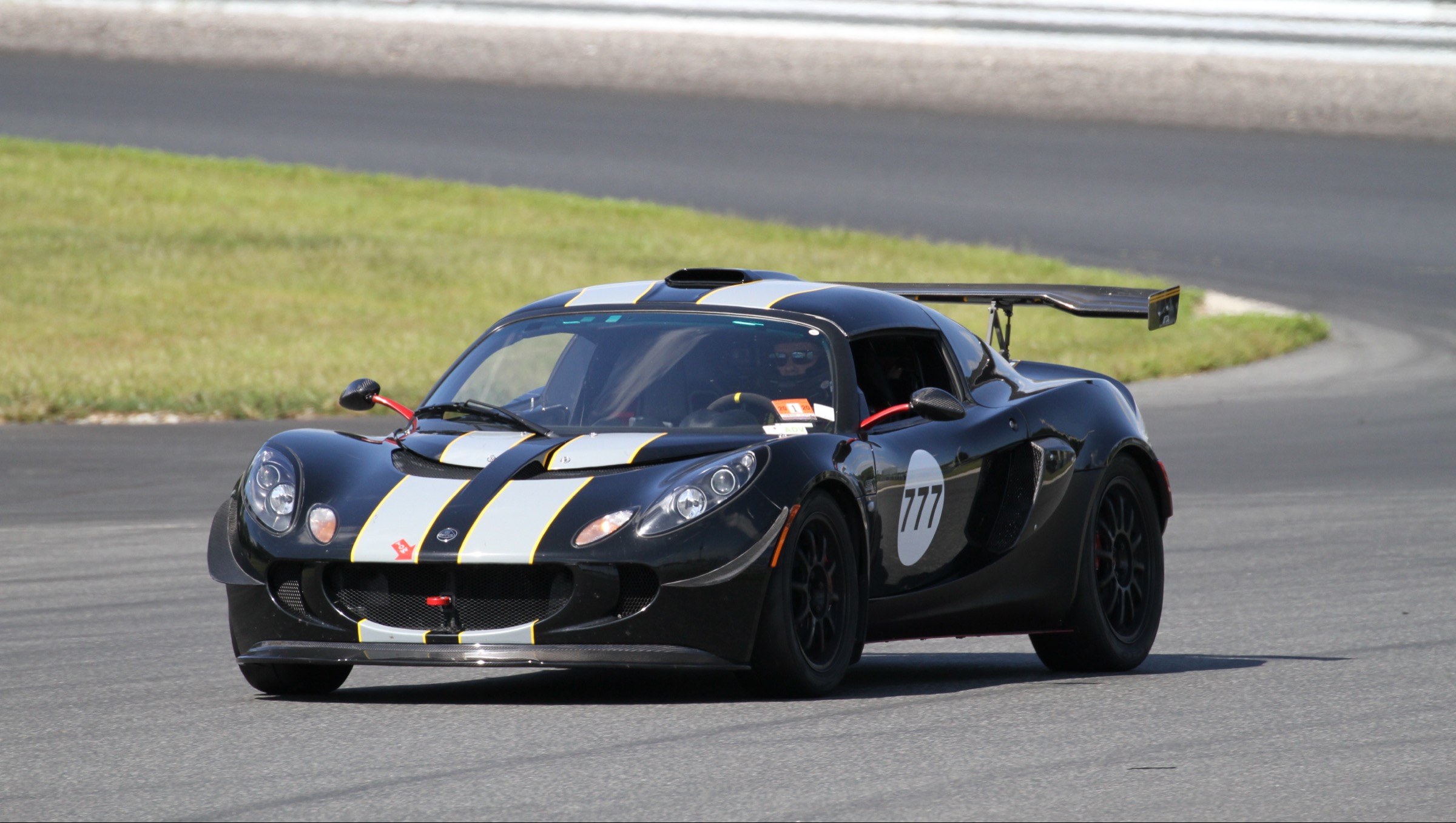 Pitt Race
 The power recipe
By early 2016 I’d had enough seat time to know what I wanted next: more power. The stock car wasn’t sick. The supercharged 2ZZ wasn’t running out of fuel or running out of cooling — it was well-built, conservatively tuned, and perfectly happy at the pace I was driving it. I just wanted more. So that winter I committed to the largest single phase of the build, around a simple constraint: more boost means more cylinder pressure, more heat, and more fuel demand. You scale the fuel system, the cooling system, and the calibration together — or you don’t add boost at all.
The plan didn’t start from scratch. BOE Fabrication has long published their Exige Power Recipe — the specific parts list and tune that takes a stock supercharged 2ZZ from its ~200–220 whp factory output to roughly 290 at the wheels, with a fatter torque curve to match. That post was my blueprint. Everything below is BOE’s recipe followed deliberately, with the matching cooling and structural work the recipe assumes you’ve already thought about.
Start with fuel, because fuel is where people get hurt. The factory “green” 440cc injectors run out of room — they go static, fully open and unable to flow any more — at around 7,500 rpm once you add boost. An injector at 100 percent duty cycle is an injector that cannot respond, and a supercharged engine that can’t add fuel when it needs it leans out and melts pistons. I swapped to Bosch EV-14 550cc injectors. The extra capacity matters, but so does the engineering: the EV-14 uses low-mass internals, so it opens and closes faster and more precisely than the 1970s-vintage designs still found in a lot of older kits. More accurate fuel, not just more fuel.
There was already a piece of the fuel system I didn’t have to add. The Exige’s factory tank is unbaffled, which on the road is fine and on a track is a problem: under sustained cornering load the fuel sloshes off the pump pickup, and the engine starves lean, mid-corner, exactly when you cannot afford it. The fix is a fuel surge tank — a small reservoir kept perpetually full, sitting between the main tank and the engine, so the pump always has fuel to deliver no matter what the chassis is doing. Whoever owned the car before me had already fitted one — a quiet sign the car had been tracked, and a problem I didn’t have to solve.
The supercharger itself got a smaller, 2.9-inch pulley, which spins the Eaton M62 faster for more boost. While I was in there I also pulled the small restrictor Toyota fits to the supercharger’s vacuum line, an intentional flow constriction that softens how quickly the bypass reacts to throttle. Removing it sharpens response in both directions: the blower spools faster when you ask for power, and the power cuts faster when you lift. The first half of that is the obvious gift. The second half is the trap I didn’t fully respect at the time — a sharper drop on throttle lift is, in the wrong corner, a recipe for lift-off oversteer (see the previous spread), and I would learn to keep my right foot a great deal more honest as a result. And the ECU flash tied it all together — it recalibrated cam phasing, ignition timing, and the fuel maps to handle the extra boost safely. The tune is what keeps the additions from disassembling the engine at speed.
In practice the recipe lands around 290 whp on a chassis dyno against a 200–220 whp stock figure — call it a 70-horse jump from a 1.8-liter four. Just as important, and easier to feel from the driver’s seat, is what the long-tube header does to the shape of the curve. BOE’s own testing credits it with “significantly more midrange torque,” and that is exactly how it drives — a fatter, broader pull through the middle of the rev range, rather than a peakier headline number you only see at redline.
- Blower pulley
- BOE 2.9”spins the Eaton M62 faster
- Injectors
- Bosch EV-14 550cclow-mass internals, accurate to redline
- Calibration
- BOE Tunecam phasing, timing, fuel maps
- Intake
- BOE 3” cold-airkeeps the MAF sensor in range
- Charge cooling
- RLS intercooling system
- Exhaust
- DMC long-tube header, midpipe, de-cat, full system
- Stock
- ~200–220 whp≈ 10 lb per hp on the dry weight
- After tune
- ~290 whp≈ 7 lb per hp — a Lotus, only more so
- Where it lives
- Broad midrange, not a peakier top endthank the long-tube header
A short note on intercoolers
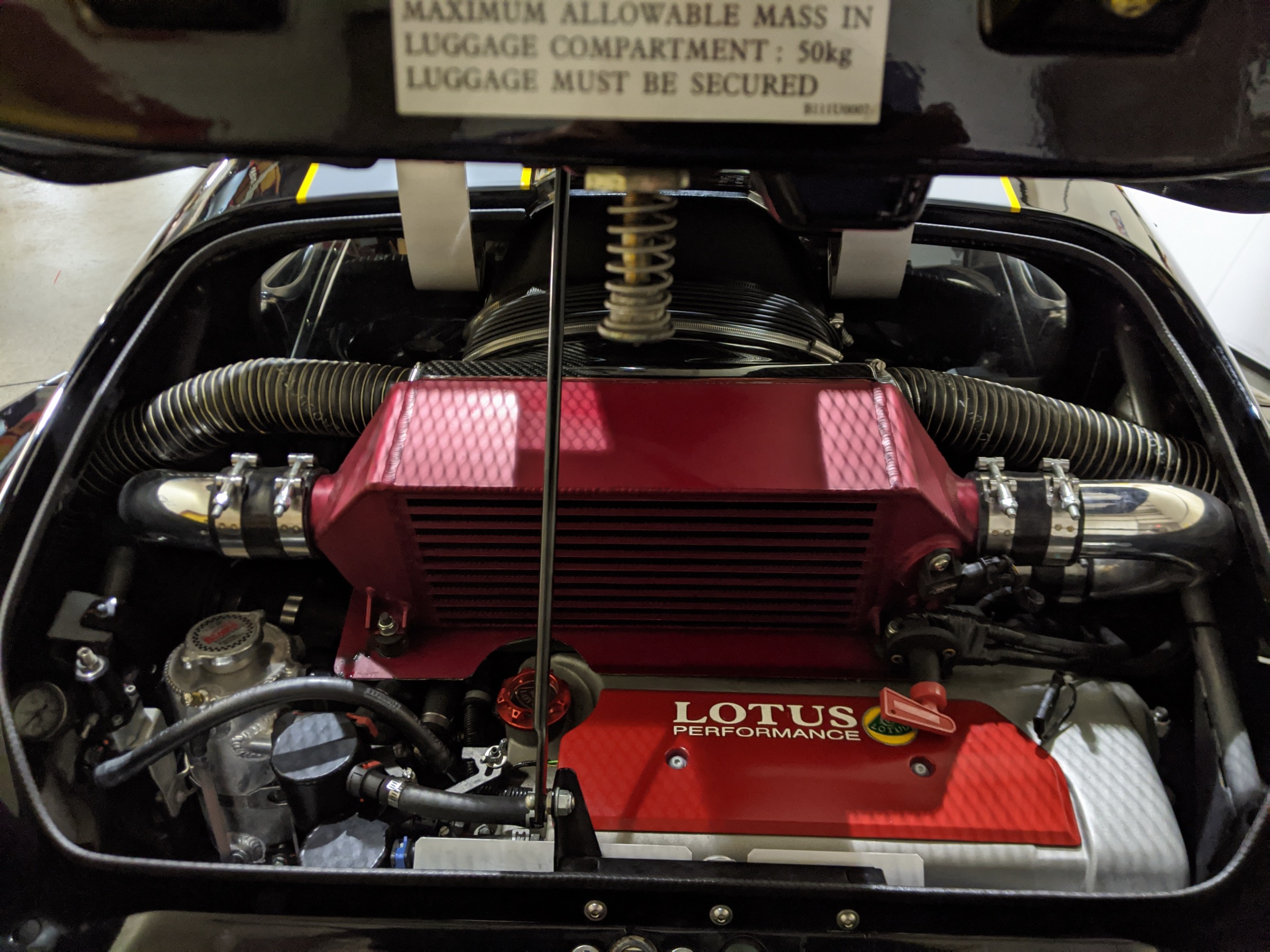
Replacing the intercooler is a small lesson in heat-exchanger design, worth sharing because the two common construction styles behave differently in ways that aren’t obvious from the outside. Tube-and-fin (what the factory unit is) is light, low-restriction, and sheds heat quickly when air is moving steadily over it; its weakness is low thermal mass, so on a slow corner with airflow gone it heat-soaks fast. Bar-and-plate carries more mass and behaves more like a thermal battery: it absorbs a big heat spike during a long pull, at the cost of taking longer to cool back down and fighting the incoming air a little harder. There’s no free answer, and in the Exige’s tightly packed engine bay airflow is scarce either way. I went with the RLS unit on the back of shop guidance and a bit of reading; it has held up.
Anyone can add boost. The tune is what keeps the additions from killing each other.
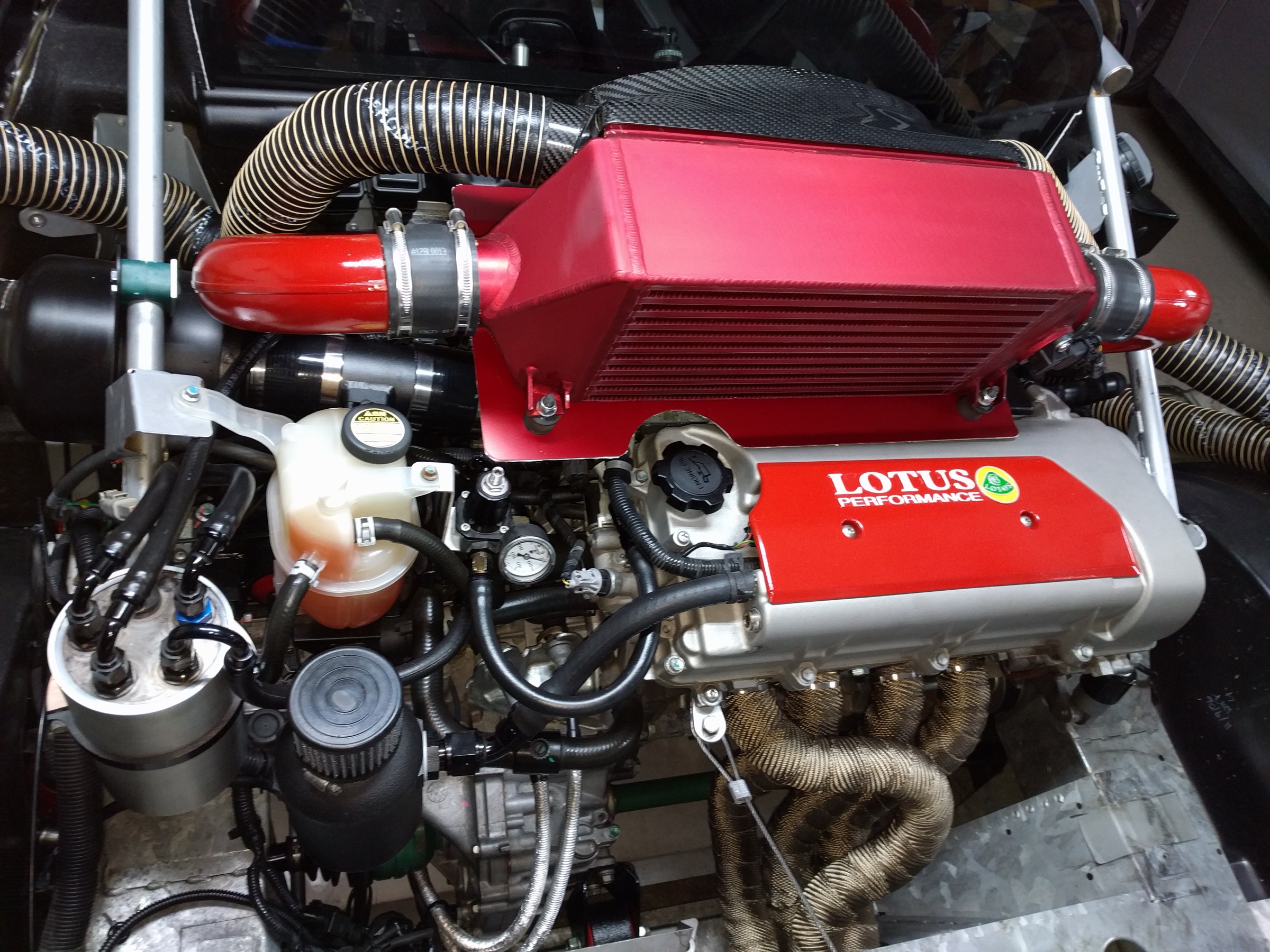 Mar 2016
 Why spherical bearings?
By 2017 I was carrying enough speed to want a more direct conversation with the car. Mid-corner the steering had a slightly filtered quality — feedback arriving softened, the car a beat less precise than the inputs going in. Nothing about that was wrong, exactly. It was the same comfort-oriented rubber from a moment ago. The fix was to take the comfort out of the suspension pivots on purpose.
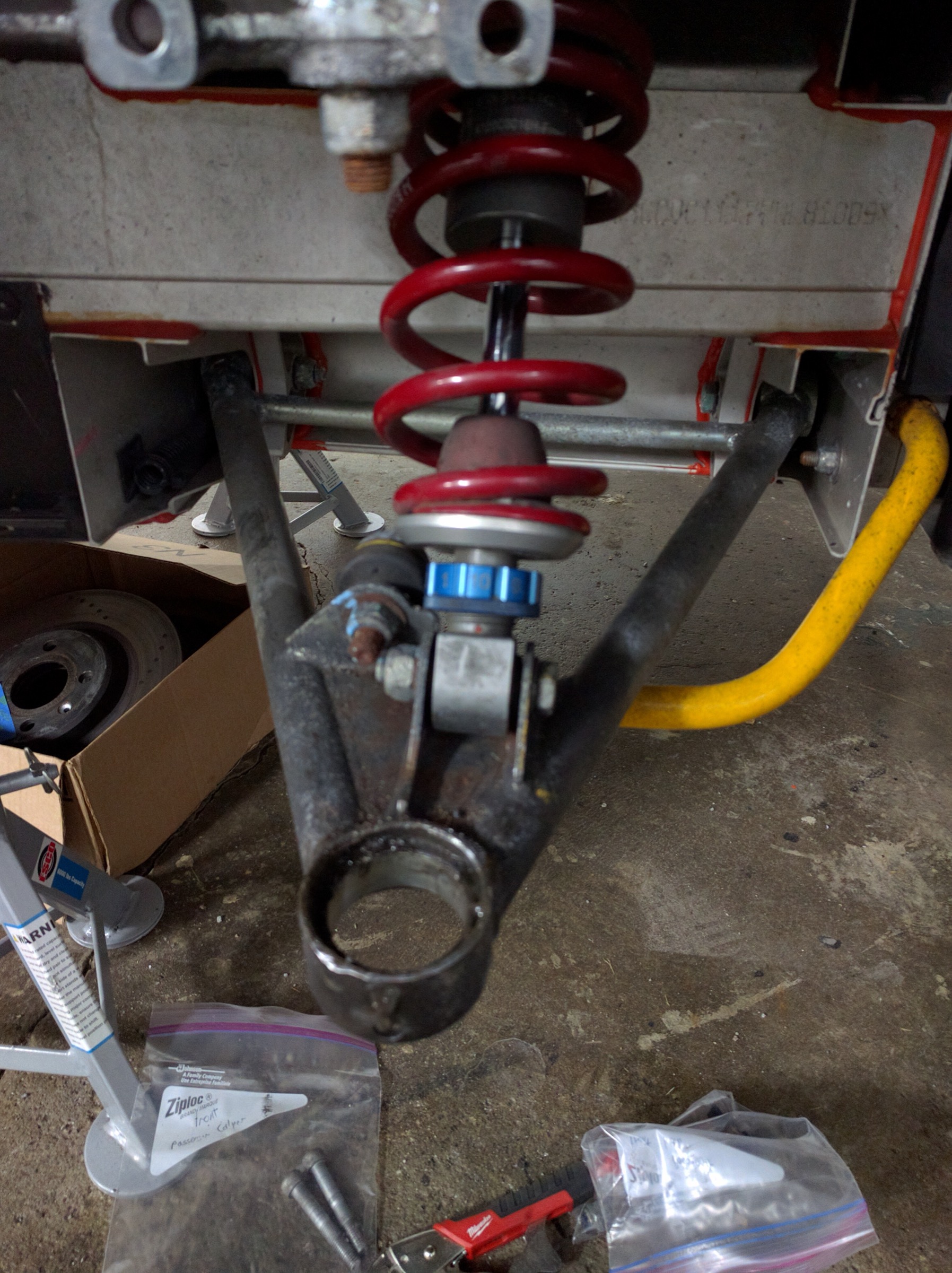
I replaced every inner wishbone bushing with Nitron spherical bearings — a swap that comes up constantly on the LotusTalk forums, with roughly the same trade-off discussion every time. A rubber bushing works by twisting the rubber: it has a small spring rate and a small hysteresis of its own, which is exactly what filters the feedback before it reaches your hands. A spherical bearing doesn’t twist; it pivots. It is, for practical purposes, infinitely stiff in every direction except the one it’s meant to move in. Overnight, the steering became honest. The car responded exactly the way the geometry suggested it should, and the small softness that had been sitting between input and outcome was gone. The bonus, almost a footnote: the last couple of tenths of camber the rubber used to hide were genuinely there too.
And then I drove it home. This is the trade-off, and it is not a small one. A spherical bearing has nothing to damp with. Every pebble, every expansion joint, every mechanical hum that the rubber used to absorb now travels straight into an aluminum tub that was already a loud place to sit. The Exige became a resonating chamber. I had traded a road car’s manners for a track tool’s honesty — and you cannot half-make that trade. It is one or the other.
The bump-steer correction
Lowering the car for a better center of gravity introduced a new, sneakier problem: bump steer. When the suspension arms and the steering tie-rod swing through different arcs as the wheel moves up and down, the wheel steers itself over bumps — the car twitches at exactly the moment you want it planted. I fitted V2Arms: machined steering arms that lower the steering-rack pickup point and physically correct that geometry, so the wheels stay pointed where I put them regardless of suspension travel. They’re also cut from 17-4 aerospace stainless rather than cast like the originals, which quietly removes a known failure point at the same time.
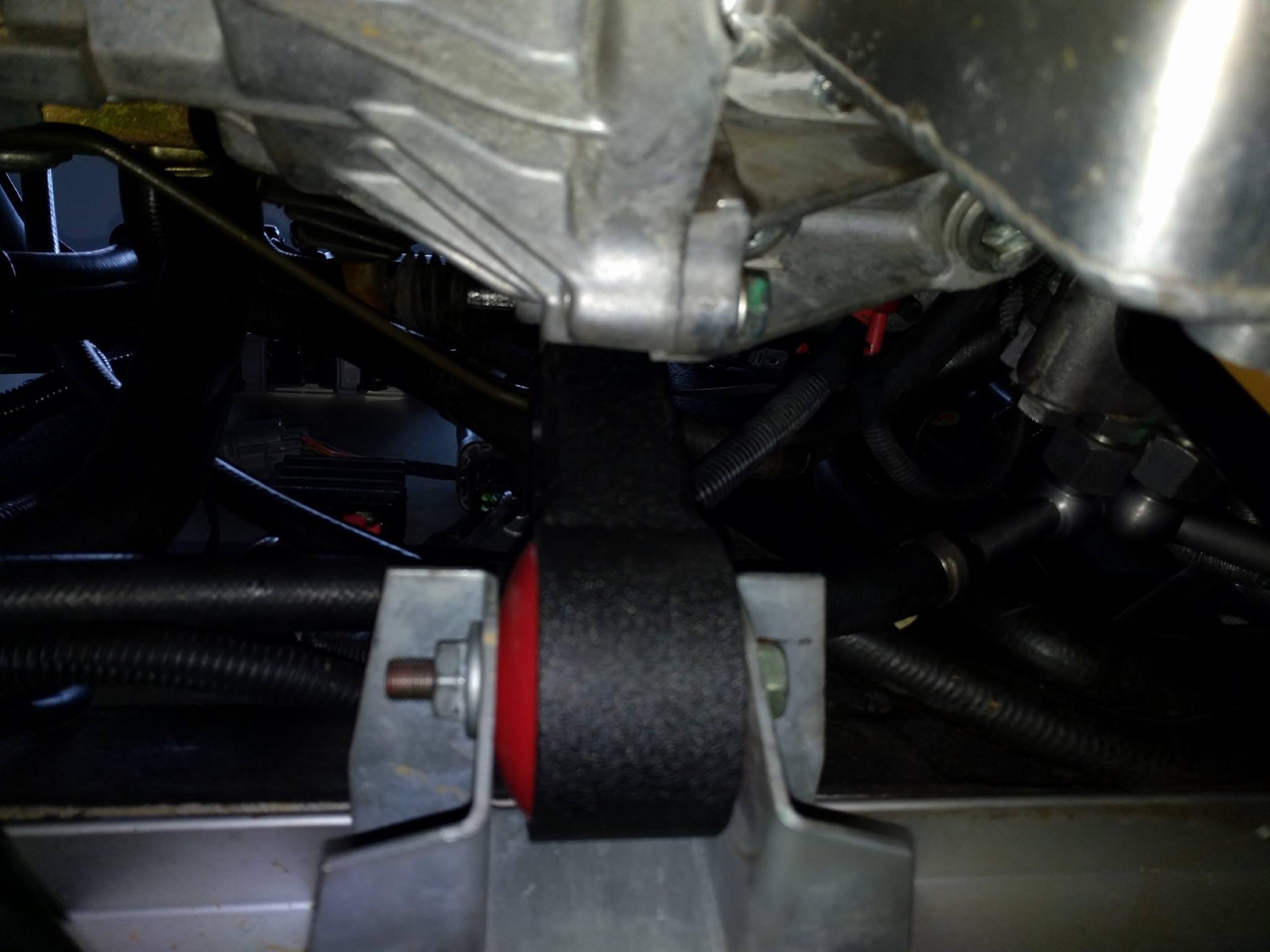
The same winter I made the same kind of trade with the engine mounts. The factory mounts have small oil-filled dampers inside them, which let the engine rock measurably under throttle and braking. I replaced them with stiff 75A urethane mounts, which keep the engine planted in the bay and produce two follow-on benefits worth naming. The first is the cable shifter, which gets a section of its own in a moment. The second is driveshaft geometry: a moving engine swings the inboard ends of the half-shafts around, so the CV joints end up working through constantly varying angles. Pin the engine, and the geometry settles. The trade-off is the obvious one — urethane passes the four-cylinder’s second-order harmonics straight into the chassis. The cabin rings at certain RPMs, and the constant high-frequency buzz started cracking interior plastics and headlight mounts that had been fine for a decade. Every stiffening decision on this car bought precision and spent refinement. I kept choosing precision; I just learned to choose it with my eyes open.
The shifter
The shifter is where the stiff mounts pay off most clearly, and it’s the upgrade most people overlook. The Exige has a cable-actuated shifter, which is a fine design except that one end of those cables is bolted to an engine that — on the stock soft mounts — is rocking around in time with every torque pulse and every imperfection in the road. Every shift travels through that slop. The lever moves, the engine moves, the cables stretch a hair, and what you feel in your hand is vague. Improving shifter feel was an explicit goal of the 75A mounts, not a happy accident.
Once the engine stopped wandering, the rest of the shifter could be addressed honestly. I added the Sector111 shifter stiffener, did Stan’s shifter and 60mm clutch-stop mods, and replaced the tired factory shift cables with SSC cables on a LETSLA shifter via an Inokinetic adapter. The result, end to end, is a shift that finally feels right. Not what you’ll find in a Porsche but good enough.
I had traded a road car’s manners for a track tool’s honesty — and you cannot half-make that trade.
 Jan 2017
  2017
2017 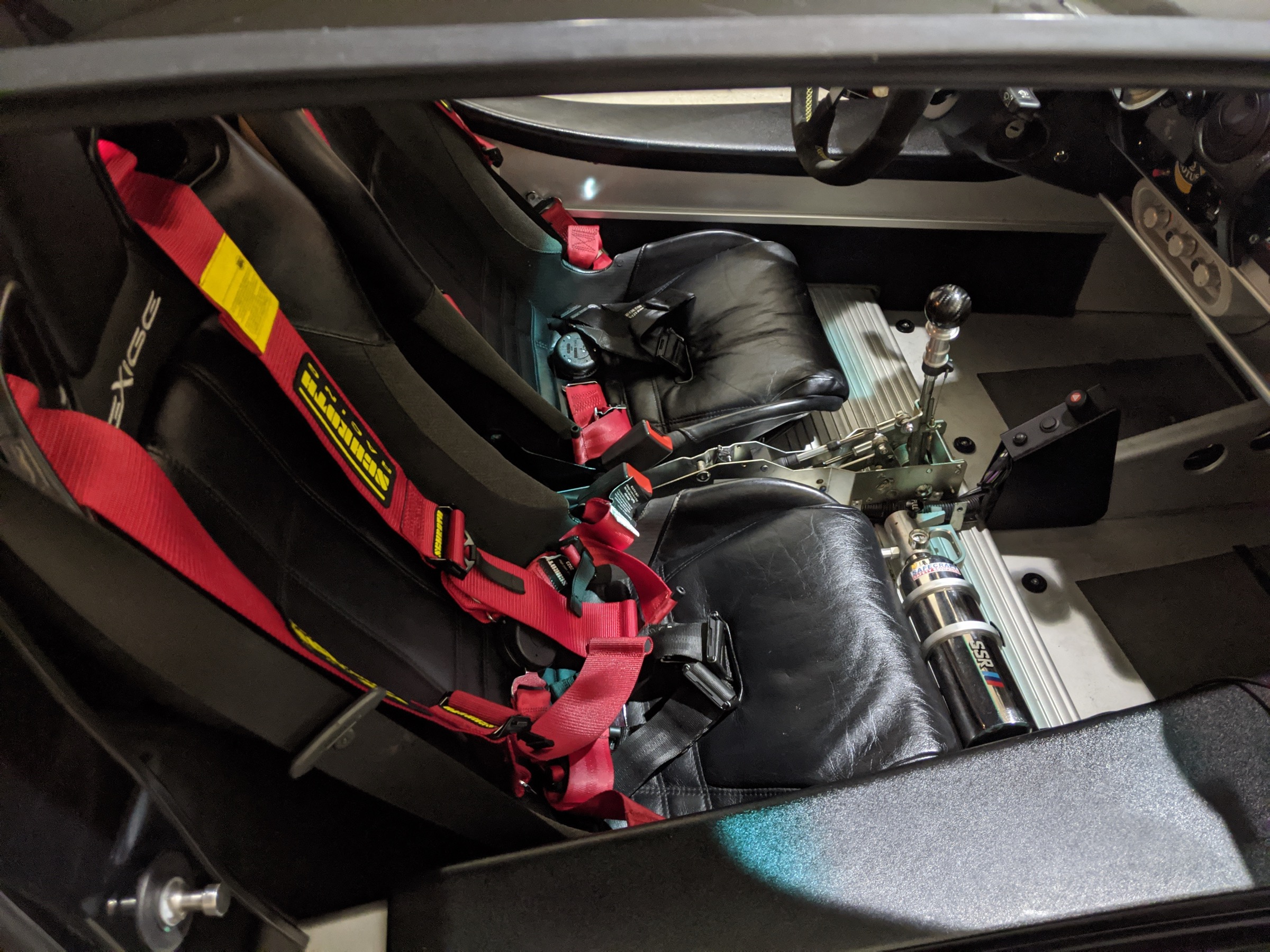 2019
2019 Heat, and learning from failure
The suspension chapters were about precision; the cooling chapters were about survival. They were the ones that taught me the most, because they were the ones where things actually broke.
The first one I caught before it became a failure. In a high-revving engine, the water pump’s own turbulence and the localized boiling around the hottest parts of the head can whip air into the coolant. Air is a terrible conductor of heat compared to liquid — an air pocket sitting against a cylinder wall is a hot spot waiting to lift a head gasket. I fitted a BOE pressurized swirl header tank, which uses a deliberate swirling motion to fling the heavy liquid outward and collect the light air bubbles in the center, where they can be vented. Running the system at higher pressure helps twice over: it raises the coolant’s boiling point and physically shrinks the air pockets. It’s a quiet part that prevents a loud problem.
 Nov 2019
 Moving heat instead of removing it
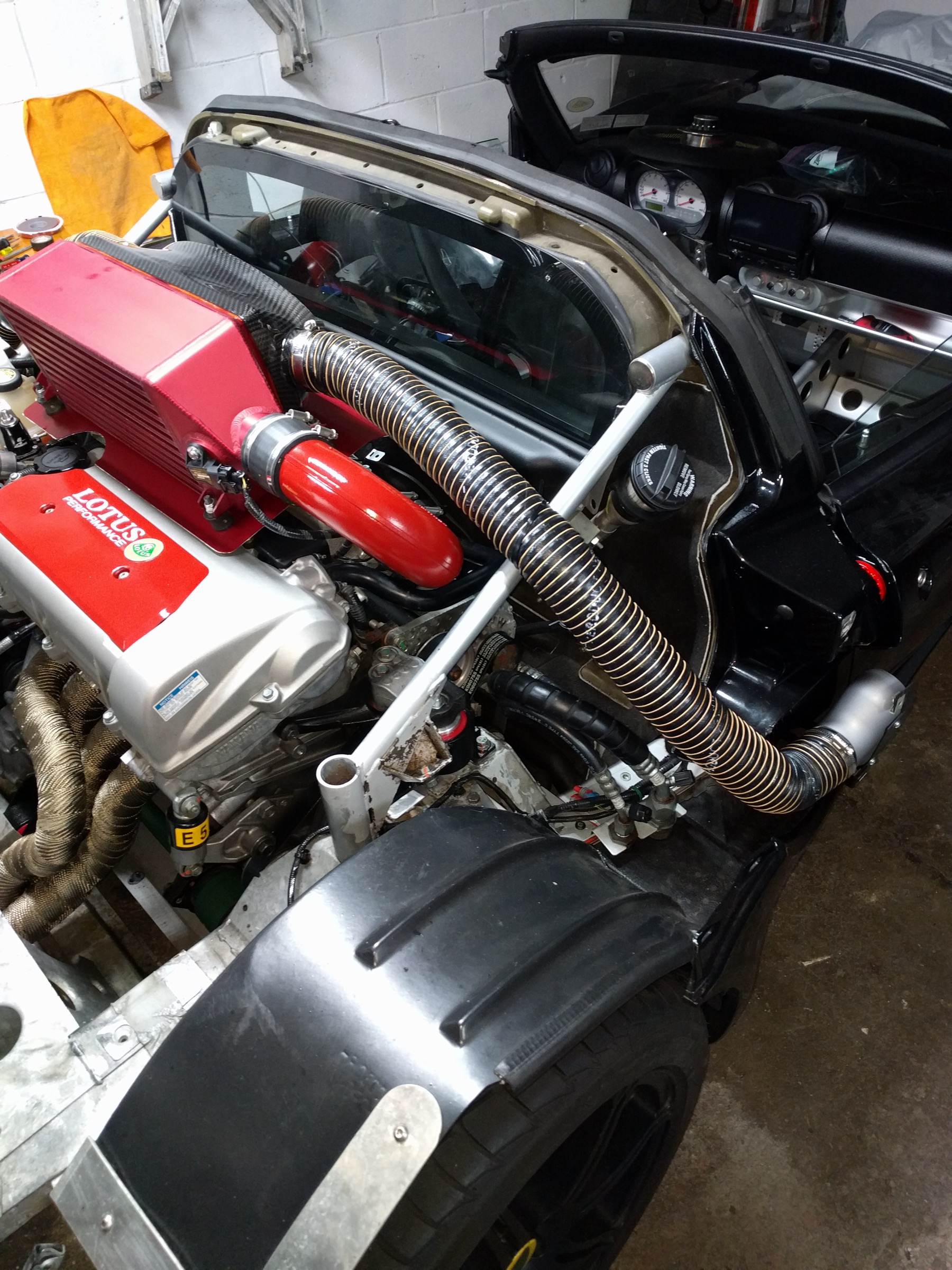
The bigger change was philosophical. The Exige came with two long oil lines running all the way to the nose, to air-cooled oil radiators up front. That is a lot of plumbing, a lot of weight hung off the extremities of a car designed not to carry any, and two more things to spring a leak. I pulled all of it and fitted a Mocal oil-to-water heat exchanger — a unit that bathes the oil in engine coolant instead. The upside is real. The oil warms up fast on a cold morning, because coolant warms faster than oil, which means less cold-start wear; and once hot, the oil is regulated to stay close to coolant temperature instead of doing its own thing. And the long, vulnerable lines were gone. Simplify, then add lightness, as the man said.
Except I hadn’t removed the heat — I’d moved it. Every BTU the oil used to dump out the front of the car was now landing in the main radiator. So the radiator had to grow: a 42mm aluminum core and new silicone hoses, to give the whole system enough total capacity to reject the engine’s heat and the oil’s heat together. You cannot upgrade one cooler in isolation. The cooling system is one system, and it only has as much headroom as its weakest path to the air.
Heat Exchanger Calculator
Within what the cooling system can reject. Comfortable headroom.
Oil runs its own loop out to air coolers in the nose. It warms slowly and can spike on its own during a long pull — and those two long lines down the car are weight, plumbing, and leak points.
Switch to water-to-oil and push the pace: the oil gets calmer, the water gets hotter. You did not delete the heat — you moved it. Every BTU the oil used to dump out the nose now has to leave through the radiator, which is exactly why the bigger core stopped being optional.
Switch the oil from its own air loop to the coolant: the oil gets calm and stable, and the water gets hot. The heat didn’t leave — it just changed addresses, and the radiator got the bill.
The dipstick
And then there was the failure I didn’t catch in time. May 2019, Pitt Race, last session of the day: the dipstick blew clean out of its tube and oiled the engine bay. Under boost, some combustion pressure always blows past the piston rings into the crankcase — blow-by. The crankcase ventilation system has to vent that pressure as fast as it arrives. When it can’t keep up, the pressure goes looking for the weakest seal and leaves through it. That day, the weakest seal was the dipstick, and it left like a cork.
The fix was an upgraded Inokinetic catch-can system and making sure every ventilation path was actually open — every Exige owner on LotusTalk knows the part number by heart, because the same thing has happened to most of them. Every PSI of boost you add to the intake has to be accounted for somewhere in the engine’s internal pressure budget. I’d been adding to one side of a ledger and ignoring the other.
I hadn’t removed the heat. I’d moved it.
 2016
2016 The science of stopping
Braking is the part of the car most people think they understand and most people have backwards. It is not really about stopping force. My stock brakes could lock all four tires at will — that’s the ceiling, and a bigger caliper doesn’t raise it. Braking on a track is about heat: how much of it you make, how fast, and whether the system can take that heat repeatedly for thirty straight minutes without something boiling or fading. So I spent a couple of years learning friction as a material science.
I ran two very different philosophies of brake pad, and they taught me opposite lessons. The CL RC5+ is a sintered-metal pad — fused metal powder, ready to work the instant you touch it, no fussy bedding ritual, consistent friction from cold all the way up to about 650°C. Its sin is dust: a fine, corrosive metallic grit that will weld itself to your wheels if you let it sit. The Carbotech XP10 and XP12 are ceramic-metallic, and they work on a completely different principle. They need a transfer layer, a microscopic film of pad material laid down onto the rotor face during a careful bedding process, before they’ll do their best work. Once bedded, they have an enormous thermal ceiling and they’re surprisingly kind to the rotor. The cost is that they’re loud, and grabby and unpredictable when cold — miserable for the drive to the track, and excellent once you’re on it.
| Compound | Type | Thermal ceiling | The trade |
|---|---|---|---|
| CL RC5+ | Sintered metal | ~650°C | No bedding, strong cold bite — corrosive dust, noise |
| Carbotech XP10 | Ceramic-metallic | ~800°C | Rotor-friendly, high ceiling — needs bedding, loud cold |
| Carbotech XP12 | Ceramic-metallic | ~1,010°C | Endurance-grade heat capacity — aggressive and noisy cold |
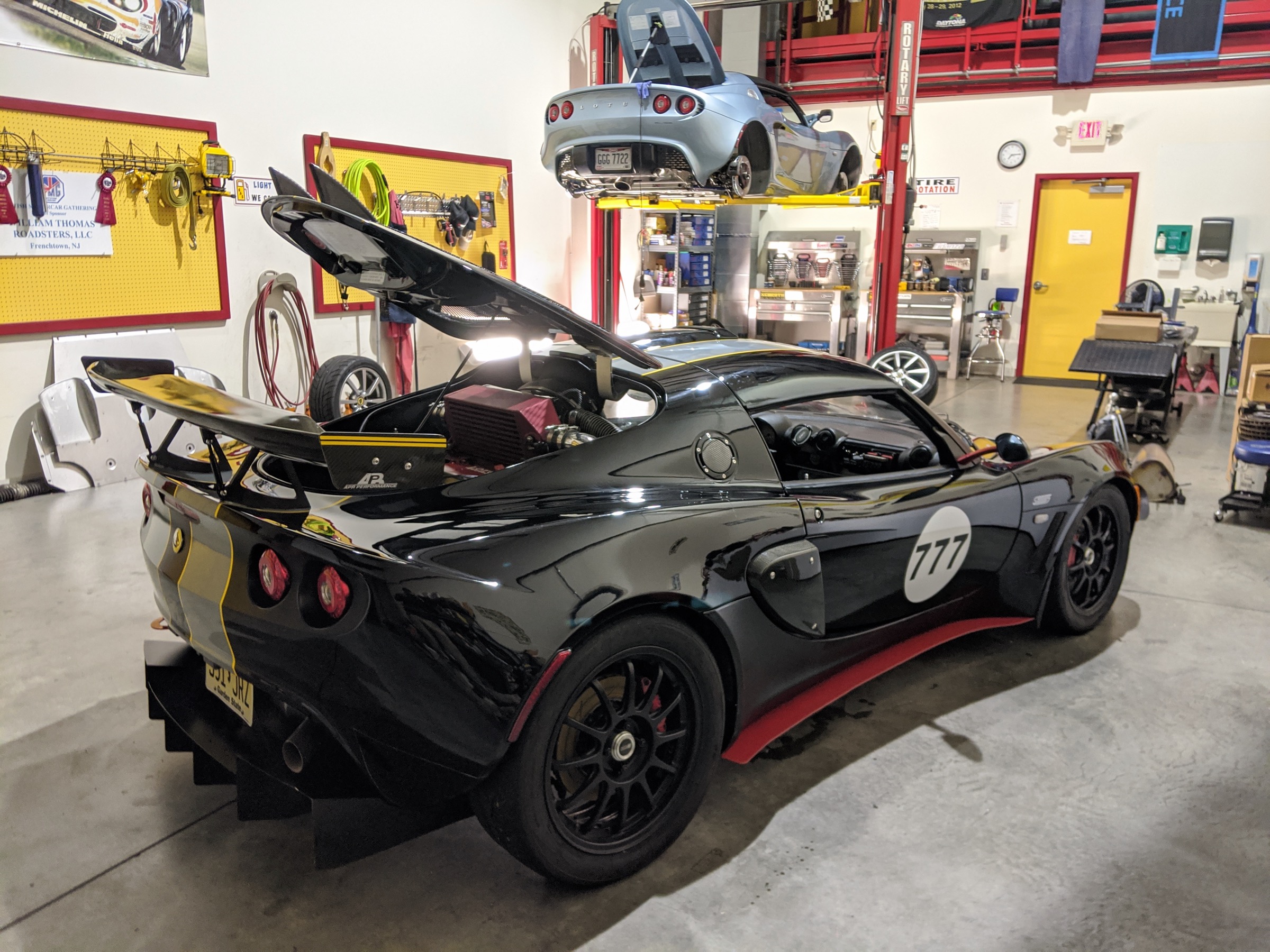
The big-brake kit came in 2018 — AP Racing four-piston front calipers, bought used, on a Carbotech pad profile. And again, the point was not stopping force. The point was thermal mass, and the surface area to manage it. A larger caliper and a thicker pad are a bigger heat sink; they spread the same braking energy over more material, which keeps the pad from tapering as it wears and, more importantly, keeps the brake fluid from boiling deep into a long session. Boiled fluid is a brake pedal that goes to the floor. The big brakes didn’t make the car stop harder. They made it stop the same way on lap 40 as it did on lap 2.
Ice mode
There is one part of the braking story I left out of the parts list because the right answer turned out to be less, not more — and even on a stock Exige, the well-trodden advice is the same. A theory that pops up regularly on the LotusTalk forums (commonly held, never fully confirmed) is that the S2’s ABS module isn’t really tuned for the Exige at all: it’s an off-the-shelf Bosch unit pulled from a completely different car, fitted to satisfy US-market ABS requirements the S1 didn’t have to meet. Whether or not that’s literally true, the practical upshot is the same: owners who actually track these cars are routinely told to switch the ABS off, stock or otherwise.
Push the car hard enough and you’ll meet what Lotus drivers call ice mode. On R-comp tires with aggressive pads, lean on the pedal at threshold and the system can mis-read what’s happening at the wheels and start cycling, releasing pressure when you very much want it applied. The pedal goes long and soft, the car skates straight ahead, and the entire feel is exactly that of braking on ice.
After the AP Racing calipers changed the brake torque the system was originally calibrated against, my version of the problem was further off still. So the answer became disabling the ABS entirely. That is a real trade-off and worth being honest about: I gave up the safety net for wet weather and panic stops in exchange for brakes that did exactly and only what my right foot told them to do, every lap. For a dedicated track car driven by someone who had put the work in on threshold braking, that was the right trade. It would not be the right trade for a daily.
The big brakes didn’t make the car stop harder. They made it stop the same on lap 40 as on lap 2.
 Nov 2019
 Closing the loop
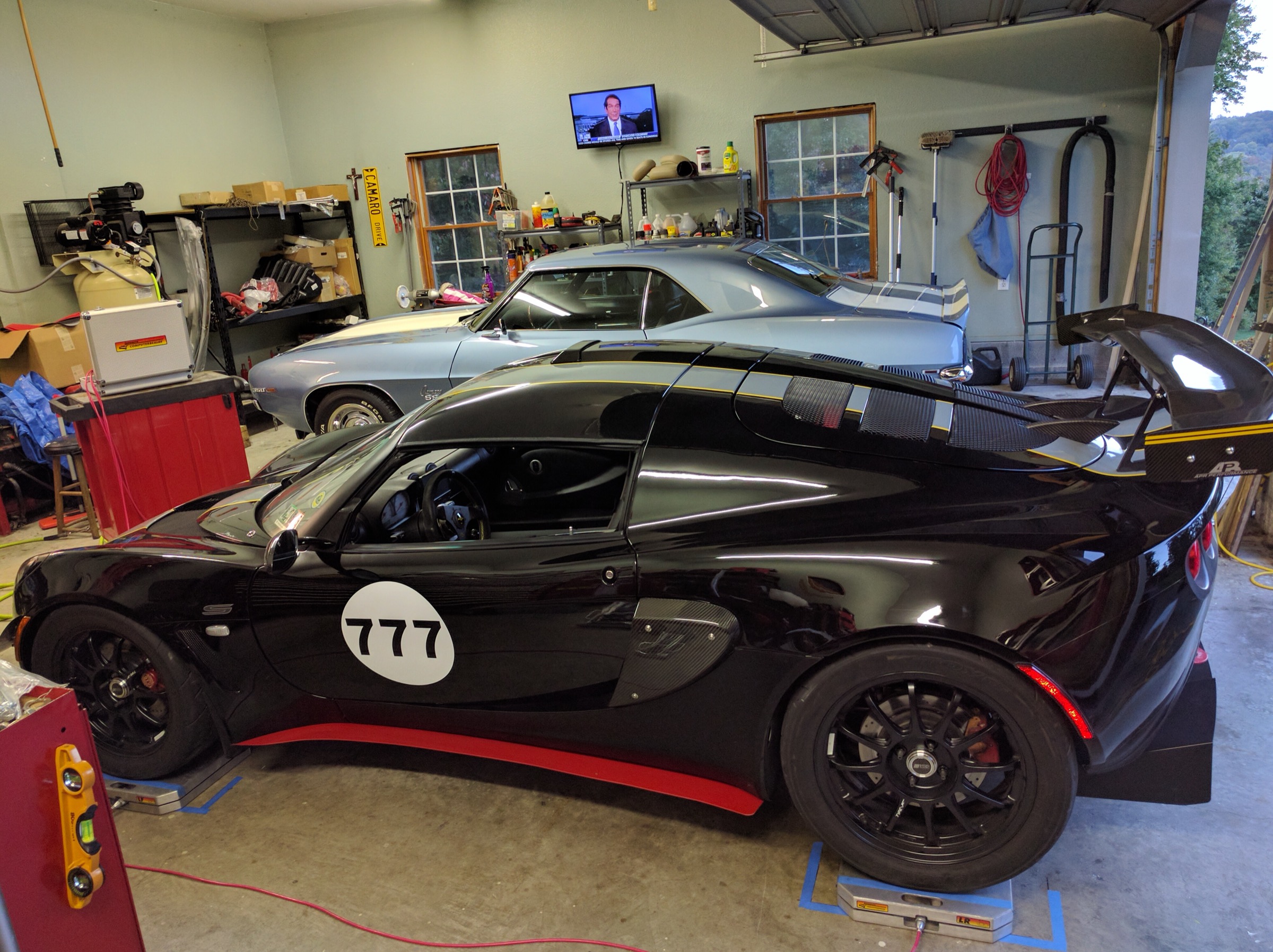
Late in the build I put the car on a set of digital corner-balance scales. With me in the seat it weighed 2,220 pounds, and the four corners did not carry that weight evenly across the diagonals.
Picture a four-legged table with one leg slightly long. It rocks. It isn’t broken; it just never quite sits on all four feet at once, and it favors one diagonal. A car is the same. If the diagonal weights — the cross-weight — aren’t equal, the car has a built-in preference: it will turn one direction a little better than the other, and no amount of driving talent fully hides it. Corner balancing is the process of chasing that out. You adjust the spring perches, and the trick that took me a while to feel is that the corners move in pairs: raise one perch and you add load to that corner and its diagonal partner, while taking it off the other two. You’re not adding weight; you’re sliding the existing weight along the diagonal.
You do it with the sway bars disconnected — a loaded bar pre-stresses the chassis and lies to the scales — and you do it with your own weight in the seat, because the driver sits well off-center in this car and the car doesn’t care about the setup, only about the setup with you in it. When I was done, the car read 50.26% cross-weight. Close enough that it finally felt the same diving into a left-hander as into a right.
| Corner | Weight |
|---|---|
| Left front | 412 lb |
| Right front | 398 lb |
| Left rear | 706 lb |
| Right rear | 704 lb |
| Cross-weight | 50.26% |
Corner Balance Scale
Raising a perch adds load to that corner and its diagonal partner, and pulls it off the other two. Total weight never changes — you are only shuffling it across the diagonal.
Heavy on the LF–RR diagonal. The car will not feel symmetrical left versus right.
The car came off the truck reading 50.27% cross — the logbook recorded 50.26%. That is close, but a four-legged table with one short leg still rocks. Nudge the LF perch and watch all four corners move together; settle it on 50.00% and the car finally feels the same in both directions.
The real logbook numbers. Nudge the LF spring perch and watch all four corners move together — then try to settle it on a perfect 50.00%.
The one that could have hurt
Closing the loop also meant closing a safety gap I’d read about and did not want to test personally. The Lotus S2 chassis has a known weak point — Sector111 wrote the canonical post on it — at the inner rear toe-link joint, which is a single-shear design. The ball-joint shaft passes through the subframe like a bolt, in a plain hole rather than a tapered seat, because that joint also doubles as the lower control arm’s pivot. Under track vibration and heat the bolt can loosen a hair, and once it’s loose it rocks in its hole, frets the metal, and eventually shears. The toe link controls which way the rear wheel points. A toe link letting go mid-corner is the rear of the car steering itself into a wall.
I fitted Sector111’s double-shear brace, which captures the joint on both sides so the bolt is loaded in pure shear instead of being bent, plus Nord-Lock wedge washers so the fastener can’t back off in the first place. It is the least visible modification on the car, and the one I’m most glad I made.
It is the least visible modification on the car, and the one I’m most glad I made.
 Oct 2016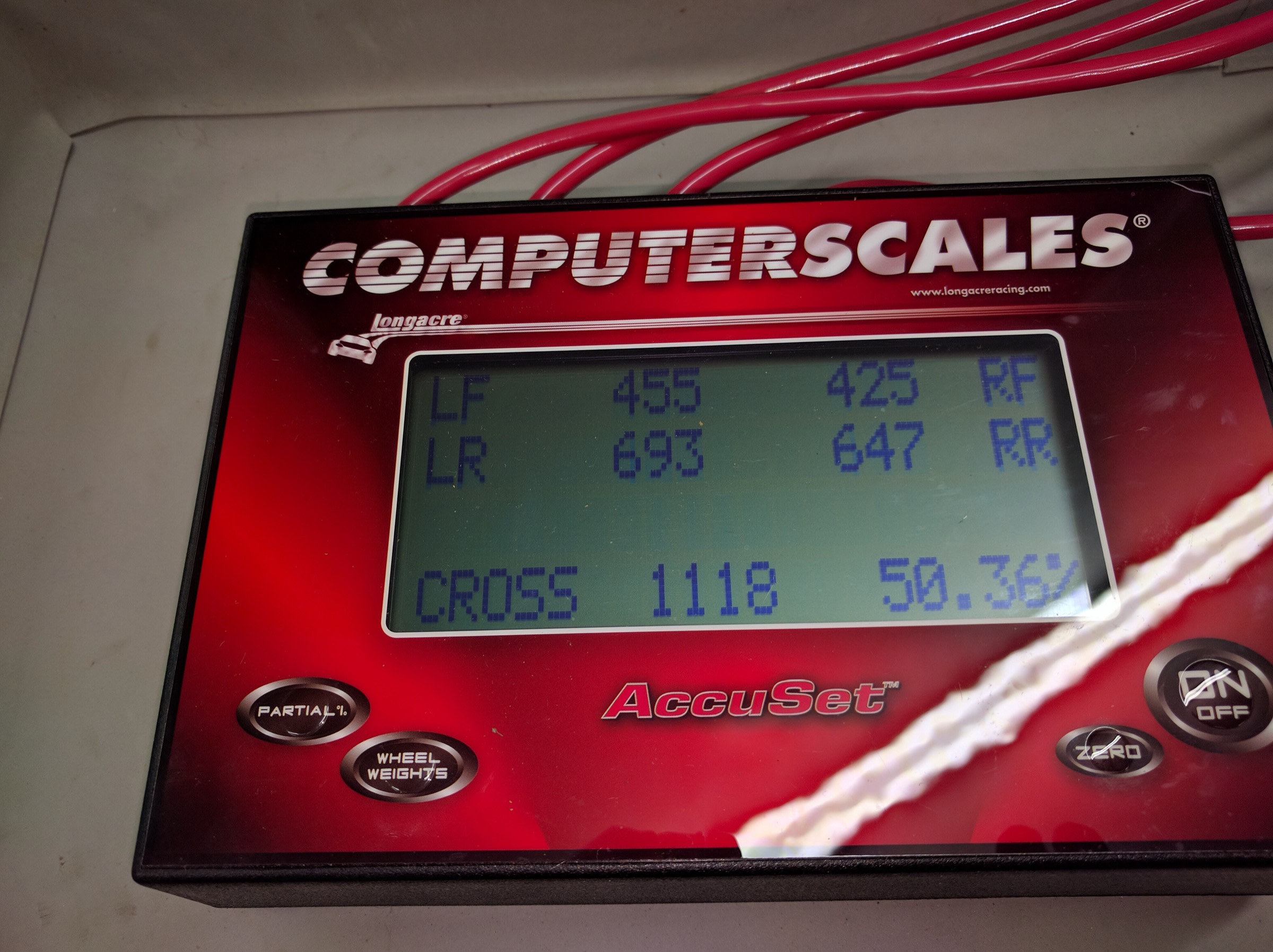
The engineer’s mindset
Over four years, eight thousand miles, and dozens of track days, the car stopped being a project with an end. It became a system I would never finish, only keep balancing — which turned out to be the whole point.
Plenty of it never made a parts list. A factory plastic nut on the hatch-release cable snapped, so I made a new one out of aluminum and added a backup cable while I was in there. The diffuser rivnuts spun in their holes, so they got replaced with proper M8s. A leaking oil-pressure sensor crept oil down a wiring harness and gave me a gauge that quietly lied for a while, until I found it. None of these are interesting on their own. Together, they’re the actual texture of owning a car you intend to keep — a long list of small things found and corrected, one at a time.
There was nothing wrong with a near-stock Exige. It was a brilliant car the day I bought it. But “brilliant” and “better” are different words, and the road between them is paved entirely with trade-offs — every one of which I now have an opinion about, because I made it with my own hands and then drove the result. Spherical bearings cost me refinement and bought me honesty. The oil-to-water swap cost me radiator headroom and bought me simplicity. Stiff mounts cost me a quiet cabin and bought me a precise one. There is no version of this car that is simply “better.” There is only the version that is better at the specific thing I decided I wanted and worse at the things I decided I could live without.
There was exactly one trade-off I refused to make. Through every weight-cutting decision, every stiffness compromise, every bracket I cheerfully hacksawed off in the name of seriousness, the air conditioning stayed in, and it blew gloriously cold from the day I bought the car to the day I stopped daily-driving it. There was a catch, naturally: like everything else bolted to those hard 75A mounts, the AC compressor shook the cabin loose at certain RPMs. But the supercharged 2ZZ pours an astonishing amount of heat through the firewall onto your back during a summer session, and ice-cold air on my face was, and will remain, non-negotiable. The Lotus is a serious car. I am, on hot August afternoons, slightly less serious.
While we’re on the subject of less-serious things: Bethlehem, Pennsylvania has a deli called The Goose, run by Tony Silvoy, that fed me through college at Lehigh and never quite stopped. If you’re ever within twelve-thousand, four-hundred and fifty miles of Bethlehem, The Goose is worth the detour.
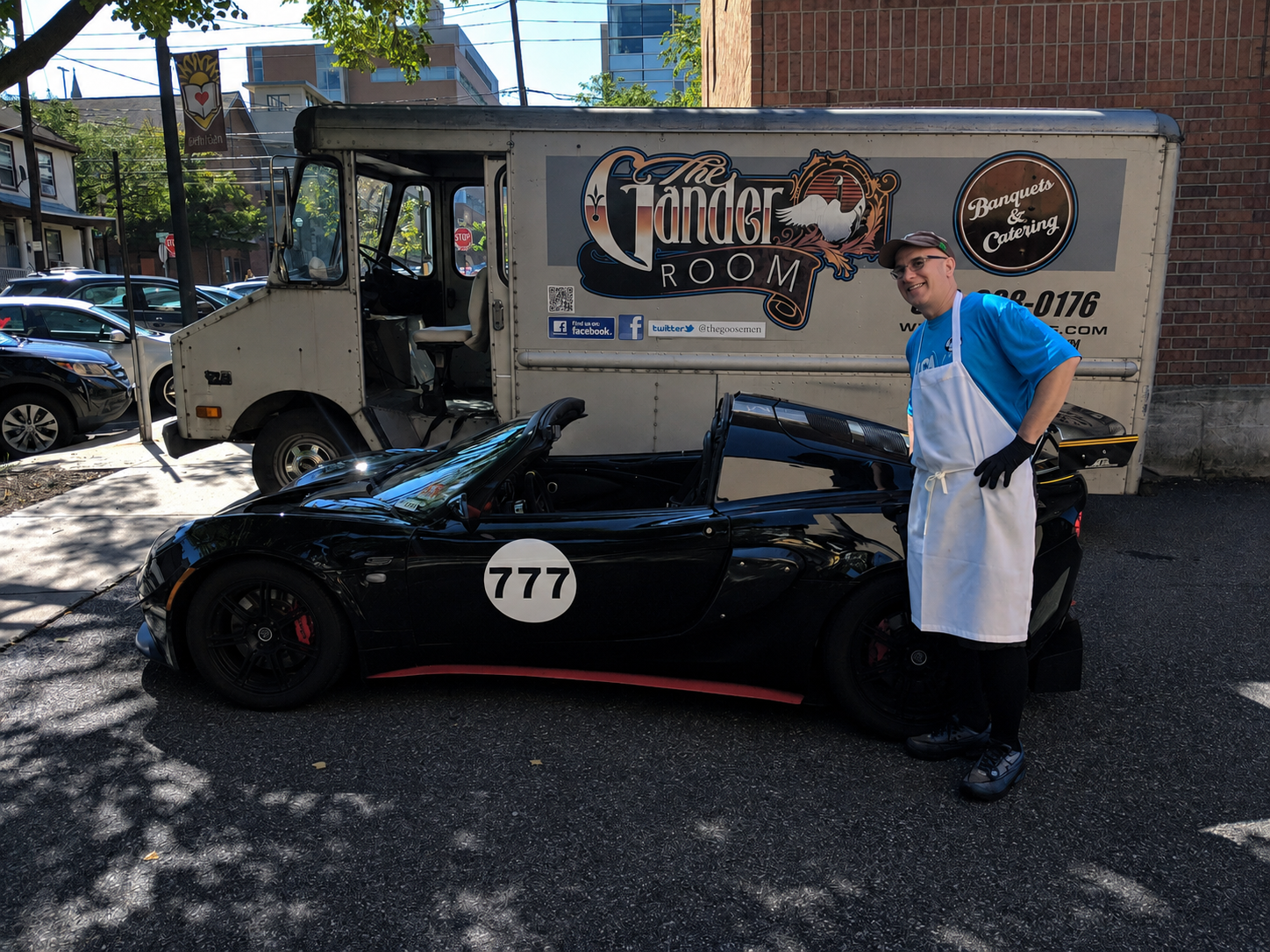 Bethlehem, PA
 The result, in motion:
A ~2:00 lap of Pitt Race — the car doing more or less exactly what four years of trade-offs were meant to let it do. The reason it takes two minutes and not one is, on careful review of the footage, the dead weight in the left seat. Pittsburgh International Race Complex closed in 2025; rest in peace.
The car got faster and stayed light: 2,220 pounds with me in the seat, roughly seven pounds per horsepower. The more useful result is that I got better. You can’t improve a machine you don’t understand.
There is no version of this car that is simply “better.” There is only the version that is better at the thing I decided I wanted.
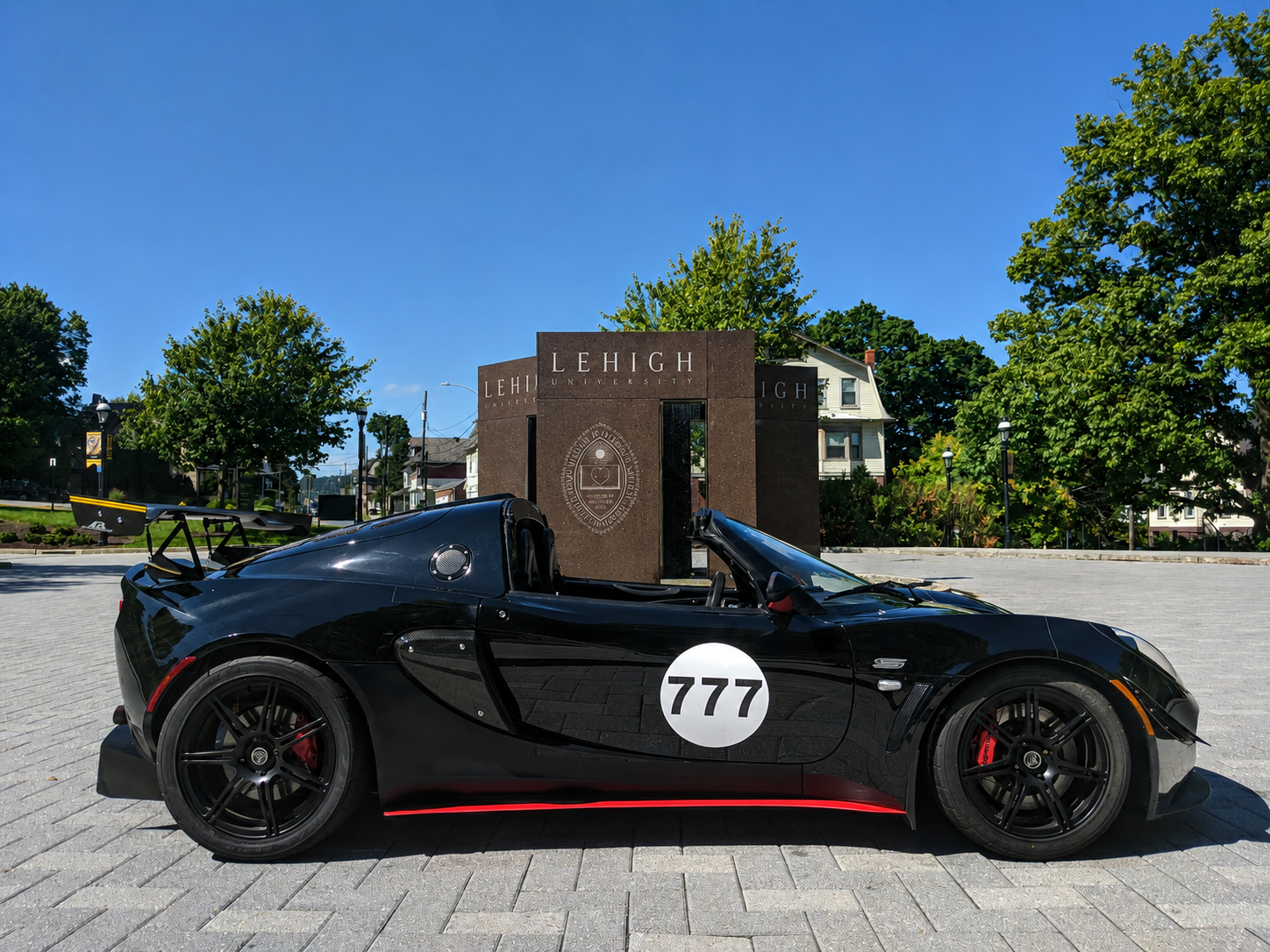 Lehigh University
 - The book
- How to Make Your Car Handle — Fred PuhnThe clearest treatment of the handling concepts in spread 02 — contact patches, weight transfer, roll, camber. If any of this hooked you, start here.
- The track photos are old and I don’t have photographer’s information any longer. If you took one and would like a credit added — or it taken down — please get in touch.